The Investment Value Of Real Estate Transparency
On-the-ground insight on transparency as investment infrastructure.
Words by Samah Assaad in Abu Dhabi · Oct 19th, 2026
The exhibition brought together government entities, developers, investors and industry leaders around a broader discussion of what makes cities more liveable, investable and globally competitive. Among the many themes discussed, transparency stood out because its impact reaches far beyond property data.
Real estate transparency is investment infrastructure.
By improving access to reliable information, clarifying regulation and making transactions and performance easier to assess, it reduces uncertainty and allows capital to be allocated with greater confidence. In real estate, infrastructure is usually understood in physical terms: roads, airports, rail networks and urban connectivity. But as markets mature, information becomes equally important.
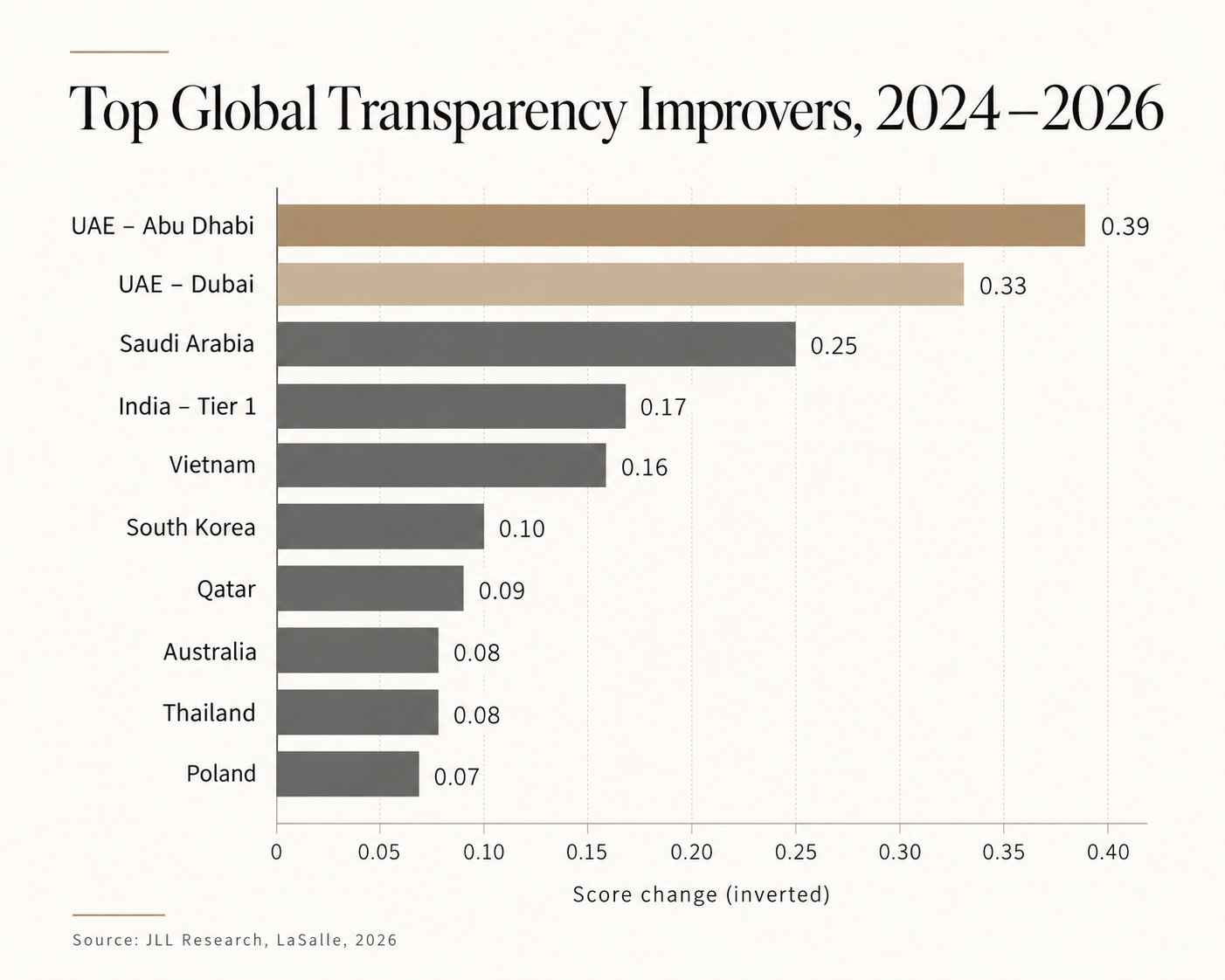
This is why the UAE’s progress in the JLL and LaSalle Global Real Estate Transparency Index deserves attention beyond the rankings themselves. In the 2026 index, Abu Dhabi was named the world’s leading improver in real estate transparency, rising from 41st globally in 2024 to 33rd. Dubai advanced from 28th to 17th.
The more important question is what this progress means for the way international capital assesses UAE real estate.
Transparency is more than publishing prices
For sophisticated investors, transparency extends well beyond access to transaction prices. It includes the quality of market data, the ability to measure performance, regulatory and legal clarity, transaction processes, governance standards and, increasingly, sustainability and building-performance information.
In Abu Dhabi, progress has included publicly available real-time property and market data, interactive transaction information, greater visibility around service charges and open-data infrastructure. The broader improvement also reflects developments in governance and regulation.
Dubai’s progress is equally relevant. JLL highlights continued digitisation and regulatory development across both emirates, while identifying the Dubai Land Department as a leader in providing publicly accessible, real-time real estate information.These may sound like technical developments. For investors, they are not.
Information changes how risk is priced
International investors do not assess an asset in isolation. They also assess the environment around it.
- Can previous transactions be analysed?
- Can performance be benchmarked?
- Are ownership structures and regulations clear?
- Can liquidity, supply, demand and pricing behaviour be understood with reasonable confidence?
The less visibility a market provides, the more assumptions an investor must make , and those assumptions become part of the risk calculation. Better information does not remove investment risk, and a transparency ranking does not guarantee performance. What transparency can do is make risk easier to understand and price.
For family offices, institutional investors and private wealth, the question is therefore not simply whether a market offers attractive growth prospects. It is whether those prospects can be analysed within a credible and measurable investment framework. That is where transparency acquires economic value.
From attractive to investable
The UAE has already built a compelling international real estate proposition around economic growth, infrastructure, connectivity, safety, taxation and lifestyle. As the market matures, however, institutional credibility becomes increasingly important. There is a difference between a market being attractive and a market being easy for sophisticated capital to underwrite.
This becomes particularly relevant as the scale of investment increases. A private buyer acquiring one residence may assess opportunity differently from a family office considering significant portfolio exposure or an institution evaluating a long-term allocation. The more sophisticated the capital, the more important the market infrastructure surrounding the asset becomes.
Why this matters beyond the rankings
Dubai and Abu Dhabi have distinct economic structures and real estate propositions, yet their simultaneous progress strengthens the credibility of the UAE as an investment jurisdiction.
JLL’s 2026 research notes that Gulf markets have made significant transparency gains over the past decade. It also finds that more than 80% of direct global real estate investment is concentrated in the 13 markets classified as “Highly Transparent”. Transparency is not the sole reason capital flows to these markets; economic maturity, liquidity and depth of capital markets also matter, but the relationship is instructive. Capital tends to favour environments it can understand.
As Dubai and Abu Dhabi improve access to information, regulation and market measurement, they reduce one of the traditional frictions associated with emerging real estate markets: the information gap.
That makes UAE assets easier to compare with opportunities in established global markets and can support more rigorous due diligence, deeper analysis and, ultimately, a broader pool of international capital.
The next stage of the UAE real estate story
For years, the global narrative around UAE property focused primarily on what was being built and the speed at which its cities were expanding. That remains important, but the next stage of market maturity may increasingly be measured by what surrounds the buildings: the quality of regulation, depth of information, credibility of benchmarks and visibility of transactions.
Physical infrastructure helps capital reach a market. Information infrastructure helps investors understand it, price risk within it and decide how much capital to allocate. As the UAE competes for a greater share of global private and institutional wealth, that distinction will matter increasingly.