This site is protected by reCAPTCHA and the Google Privacy Policy and Terms of Service apply.
Design & Architecture
A Valley in the Sky, Wedyan, Kengo Kuma's Gulf Debut
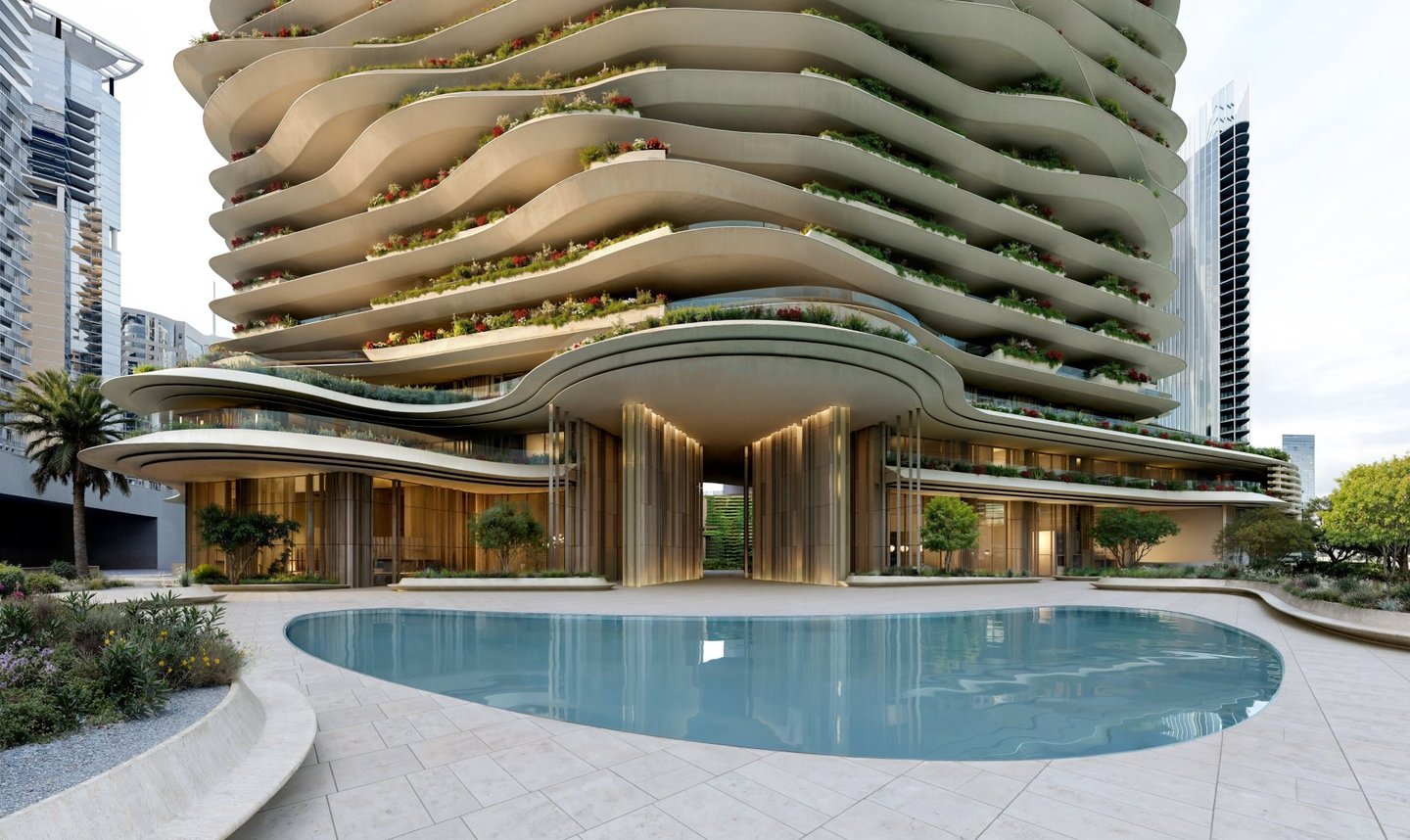
Kengo Kuma's first UAE residence reimagines the wadi with Japanese design and Gulf sensitivity.
Words by Laura Cherry in Design & Architecture · Feb 24th, 2026
Wedyan, The Canal is the debut project of Al Ghurair Collection, the super-prime portfolio under Al Ghurair Development, the new residential arm of one of the UAE’s most established family enterprises. Conceived in collaboration with Japanese architect Kengo Kuma, the project introduces his first residential tower in Dubai and his inaugural residential venture in the UAE. Positioned along the elegant Dubai Water Canal, the development signals a move towards architecture grounded in philosophy, climate awareness and material discipline. For Al Ghurair, whose history is intertwined with the Emirates’ economic formation, Wedyan represents an evolution from building infrastructure to shaping personal environments defined by design intelligence and considered spatial vision.
Wedyan - The Canal, the inaugural project by Al Ghurair Collection, marks a strategic shift for one of the UAE’s most established family enterprises. Developed in partnership with acclaimed Japanese architect Kengo Kuma, the tower represents Kuma’s first residential project in Dubai and his debut in the UAE, a significant alignment between a regional institution and one of the world’s most sought-after contemporary architects. Known for the Japan National Stadium and for an architectural language shaped by material sensitivity and environmental intelligence, Kuma’s involvement suggests a move towards globally benchmarked design thinking within Dubai’s residential market.
Established in the 1960s by Emirati businessman Abdulla Al Ghurair, the company has played a formative role in shaping the UAE’s economic infrastructure, from founding the region’s first private bank to delivering landmark construction projects across the Emirate. With more than 20,000 residential and commercial units completed over six decades, Al Ghurair’s legacy is embedded in the city’s growth. The launch of Al Ghurair Collection in 2025 extends that legacy into a new territory: a portfolio positioned around architectural authorship, scarcity and long-term collectability.
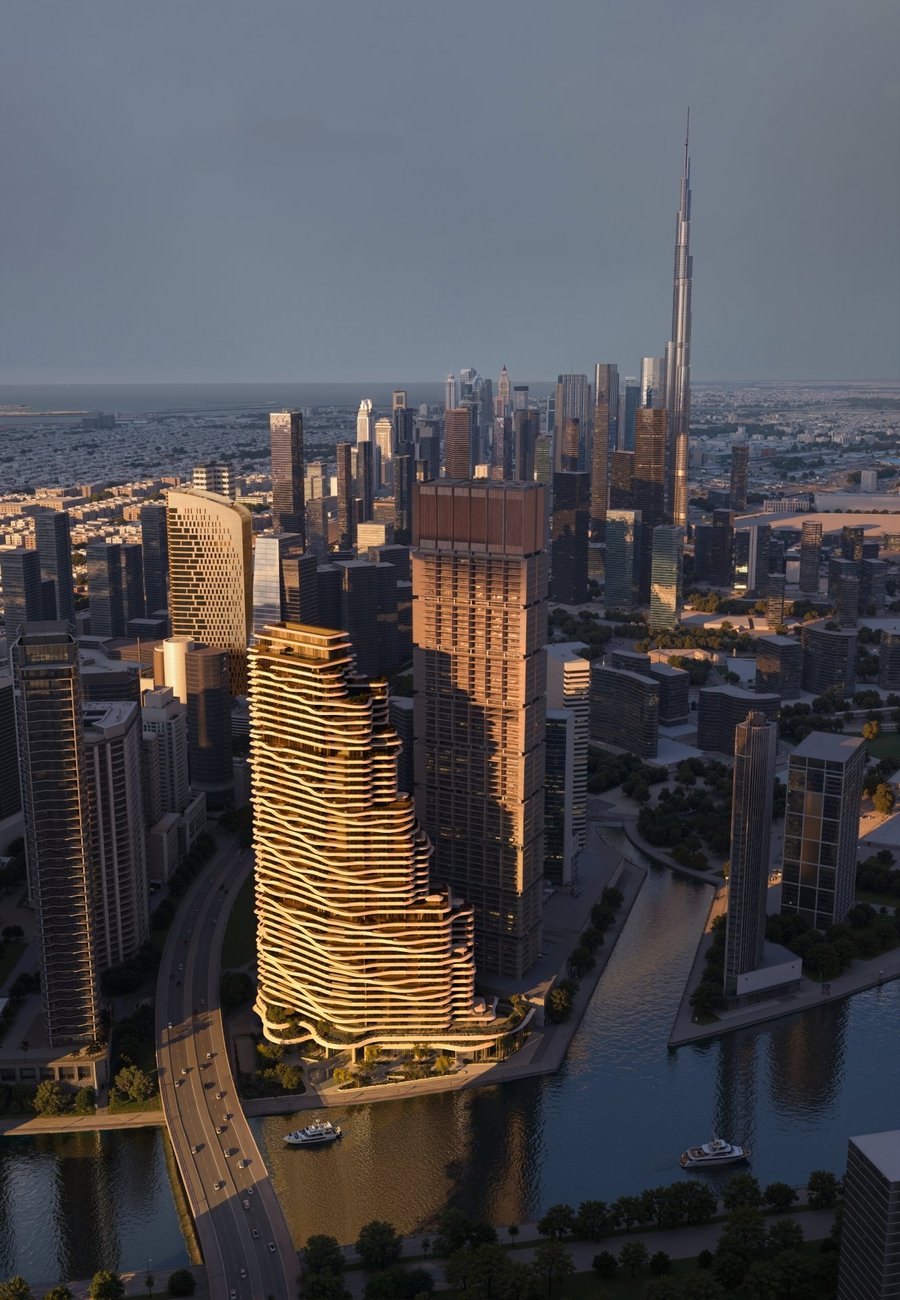
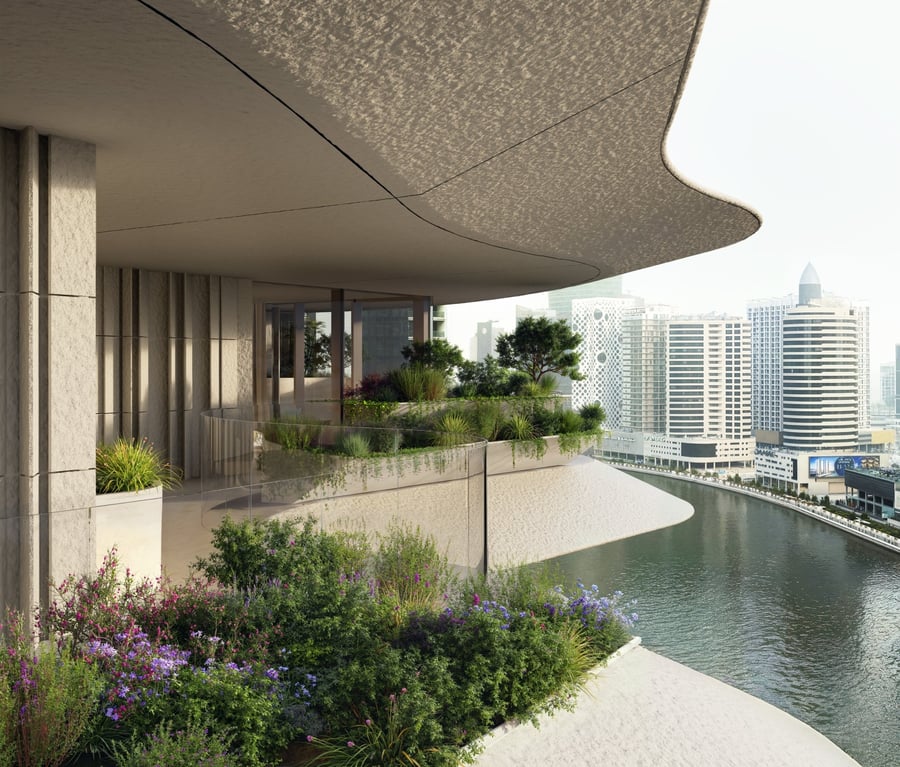
This new direction begins with Wedyan, realised through the vision of Kengo Kuma, well-known for projects that dissolve the boundary between built form and landscape, and for an architectural language grounded in material sensitivity and environmental awareness. It’s architecture that privileges shadow, texture and material subtlety. He designs with a precise understanding of climate and context in mind, prioritising openness, light and the flow of air. For Wedyan, this philosophy has been adapted to the environmental and cultural conditions of the Gulf. The name “Wedyan” roots the project in regional topography; it translates to “valleys” in English, conjuring the idea of a wadi (the natural corridor carved by water through rock). Kuma interprets this local formation at an urban scale. The 46-storey tower takes on the curvature of a mountainside gradually formed through erosion. Its layered façade creates soft ripples that channel and filter light and air across the planted terraces dotted throughout the residence. There’s no podium; the structure rises uninterrupted, articulated in stratified planes that echo weathered stone. Shadow is integral to the aesthetic and functionality of the address. Kuma has long spoken about architecture as a mediator of light, and here the orientation and façade are calibrated to create shade across terraces and outdoor living areas throughout the year. Even during the height of summer, the overhang of one level shields the terrace below. Wedyan’s terraces are made for daily use: a place to appreciate morning coffee, for intimate evening hosting, and extended family life.
The building’s relationship to landscape is also expressed through a carefully sequenced internal journey. Residents move through a series of defined zones - The Oasis, The Valley, The Shore, The Cave, The Retreat and The Mountain - each organised around a distinct way of living and state of mind. The experience starts at The Oasis, where arrival offers a moment of decompression. Here, a planted, temperature-controlled environment separates the building from the buzz of the city beyond. Residents enter through a private access point, with four basement levels of parking as well as a humidity and climate-controlled area for performance vehicles. Above, The Valley is dedicated to movement and physical vitality. A padel court, a spinning studio, reformer Pilates, yoga room and boxing facilities animate this level and integrate wellness into the everyday. The Shore places the emphasis upon leisure and sociability, with lagoon and canal-facing pools, a cinema, a golf simulator and an expansive, commercial-grade kitchen designed for private chefs and bespoke, hosted gatherings. The Cave houses state-of-the-art longevity facilities - treatment rooms, hammam, sauna, ice chamber and immersion pools - it's a space envisioned as a restorative enclave. The Mountain is reserved for business and exchange with co-working spaces, a board room, majlis, cigar lounge, podcast studio and conference suites. The idea here is to streamline the day-to-day; meetings can be taken with ease, homeowners can network, and interviews can be recorded. With more than 65,000 square feet of private amenities, the building operates as a self-contained residential infrastructure. An integrated concierge coordinates personal trainers, chefs, butlers and chauffeurs, or one can simply bring in their own. Water filtration systems remove microorganisms, meaning that tap water is drinkable throughout the address. Landscaping has been conceived in collaboration with specialists who have contributed to major international public landscapes in London and Paris, including works surrounding the Eiffel Tower. Plantlife throughout the address is thoughtfully curated, with species selected for their ability to thrive in the region’s climate.
The location is also central to Weydan’s living experience. Situated along the Dubai Water Canal, the residence sits within minutes of Downtown and DIFC while remaining slightly removed from Sheikh Zayed Road. The canal offers proximity to the tranquillity of flowing water and pedestrian connectivity, while new infrastructure investments continue to enhance access across the city. The beach is within reach with jogging and cycling tracks and Dubai’s international airport is just 20 minutes away. It’s urban convenience with a layer of retreat.
Inside the residences, in The Retreat, Kuma’s sensibility is evident in visual restraint and material sensitivity. Interiors feature subdued lighting, clean architectural lines and a natural palette of stone, glass and pale timber. Planning privileges continuity between realms while maintaining discretion in service. Every residence is configured with both a show kitchen and a fully equipped wet kitchen (with two aesthetic options available to residents), each with its own access. Across all residences, separate entrances for residents, guests and service ensure that movement through the home remains relaxed and private. Primary suites extend onto generous terraces through sliding glass partitions, allowing the interior to open outward while remaining shaded by the sculpted façade above.
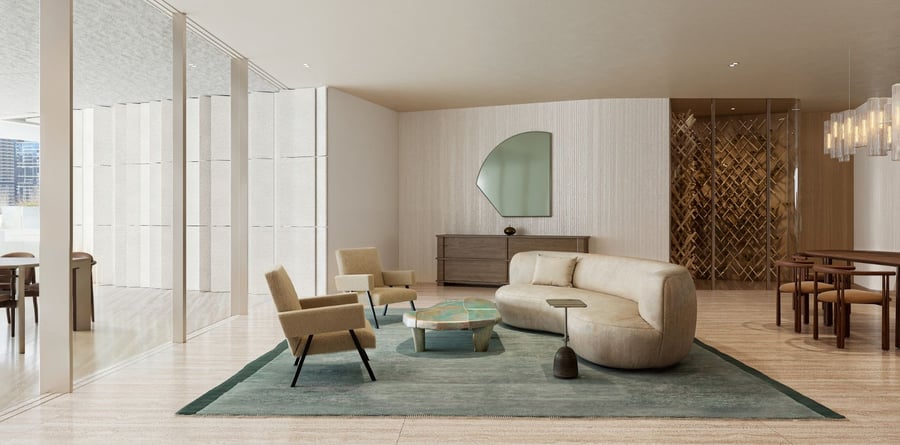
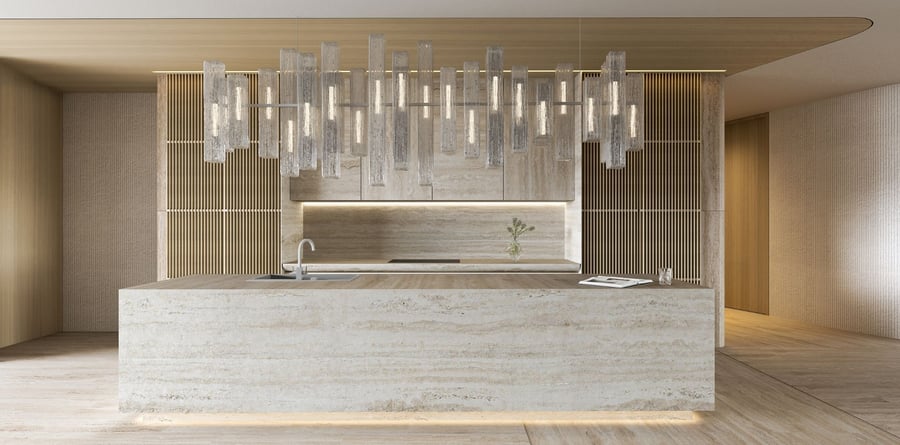
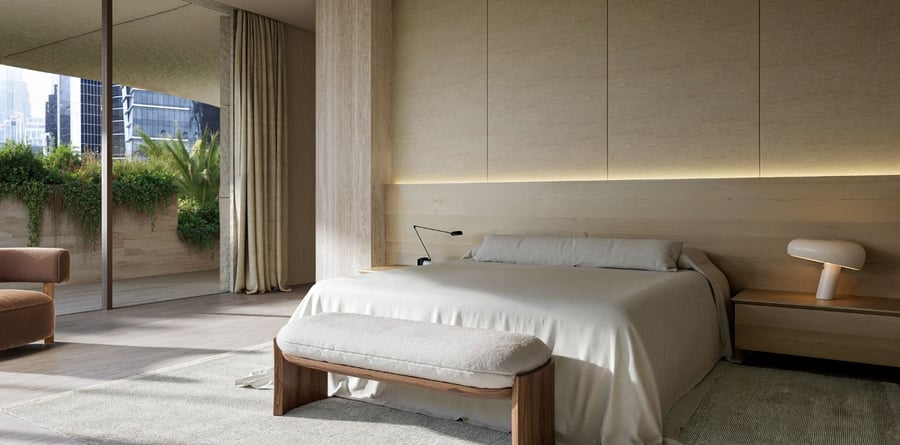
Over the 46 floors and 149 residences, layouts range from three-bedroom residences to expansive four- and five-bedroom homes. Larger configurations include staff quarters with independent access, reflecting a considered approach to contemporary domestic life and the flow of the home environment. At the summit, a single three-storey sky villa with a private pool and two penthouses with dedicated entertainment spaces introduce a more rarefied scale of living. Terraces, inspired by the proportions of Japanese teahouses, are enclosed in glass and screening so they function year-round as a majlis, library or pavilion. Bedrooms extend naturally from the principal living areas, while the primary suite and guest rooms are carefully separated through measured architectural planning under Kuma’s direction. Circulation, from the four basement parking levels to the rooftop, has been choreographed; even waste disposal is routed through the service kitchen to preserve the coherence and serenity of primary living spaces.
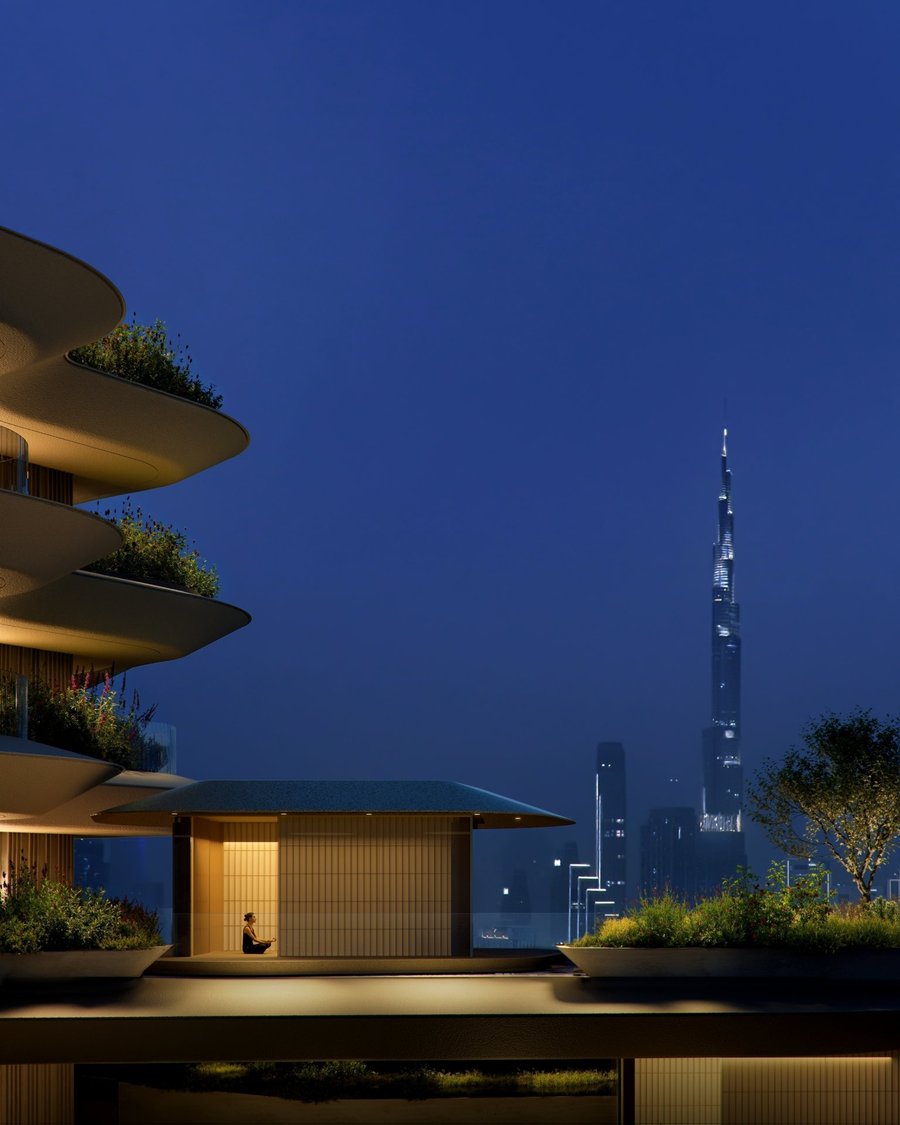
Wedyan is characterised by a powerful philosophy of flow and sequence. Kuma’s sensibility, grounded in Japanese principles, material restraint and spatial harmony, is articulated through a regional vocabulary informed by wadi formations and the rich legacy of Al Ghurair. Arrival, ascent and private dwelling are organised through topographic form, layered terraces and spatial gradation that temper exposure and prioritise privacy. Amenities come to life through carefully defined spatial chapters, progressing from active wellness and longevity to sociability and focused work, enabling residents to navigate different modes of living with ease. The result is a residential environment that combines global authorship with local grounding, expressed through a disciplined and cohesive approach to contemporary living.